

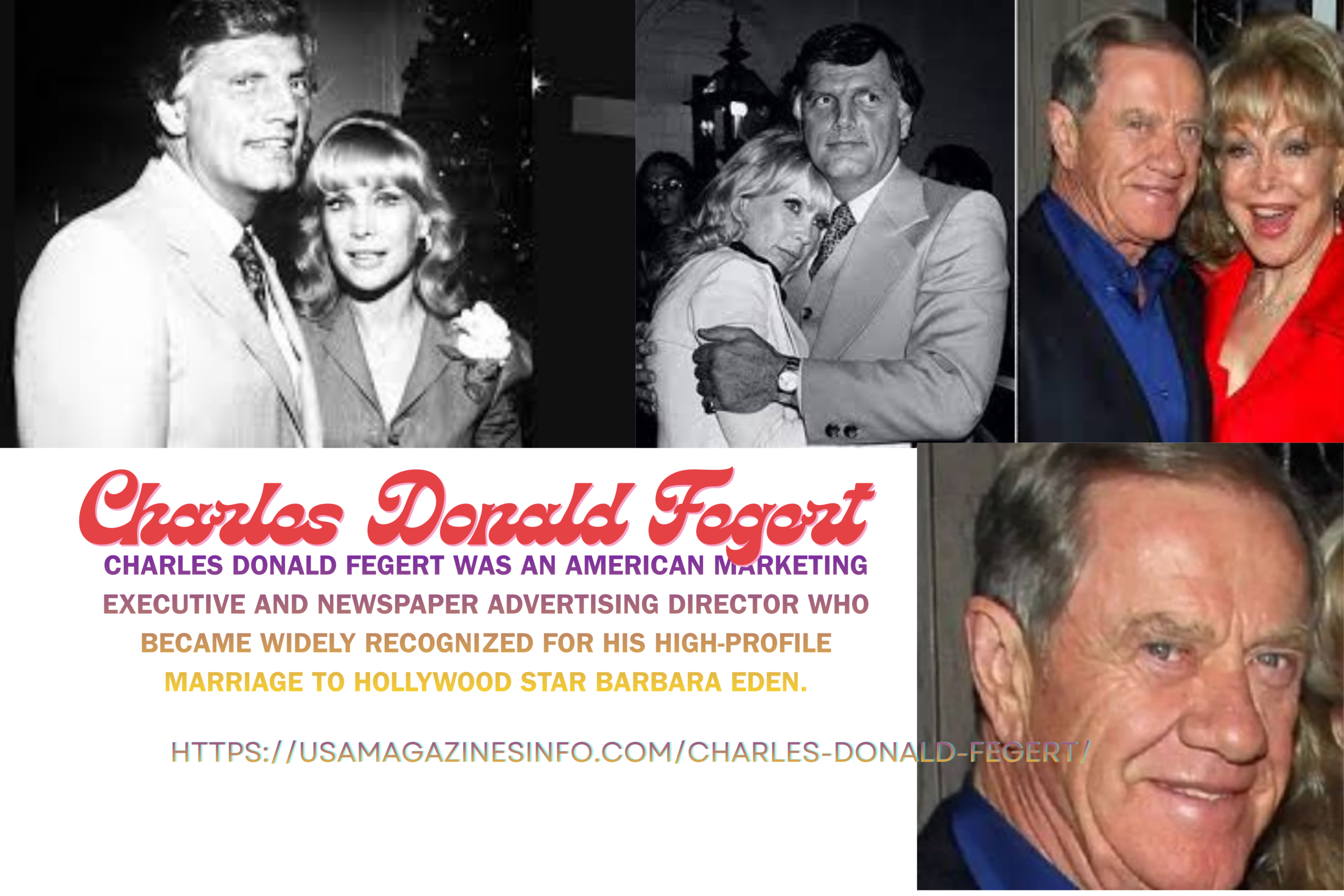
Charles Donald Fegert was an American marketing executive and newspaper advertising director who became widely recognized for his high-profile marriage to Hollywood star Barbara Eden. Professionally rooted in major print media operations, Fegert spent years working within competitive corporate landscapes, including serving as a senior executive for the Chicago Sun-Times. Although he maintained a private lifestyle following his high-profile relationship, his connection to television royalty permanently cemented his place within American pop culture history.
Quick Biography
Charles Donald Fegert Biographical Entity Data
| Entity Property | Fact / Information |
|---|---|
| Full Name | Charles Donald Fegert |
| Date of Birth | November 8, 1930 |
| Date of Death | September 25, 2002 (Aged 71) |
| Physical Appearance | 6 feet 0 inches (183 cm) / 180 lbs (81 kg) |
| Profession / Career | Marketing Executive, Newspaper Advertising Director |
| Family Life | Ex-spouse: Barbara Eden (married 1977–1982) |
| Net Worth | Estimated estate value of $2 million at passing |
| Nationality & Ethnicity | American (Caucasian) |
Early Life and Family Background of Charles Donald Fegert
Charles Donald Fegert was born on November 8, 1930, in the bustling city of Chicago, Cook County, Illinois. Growing up in the midwestern United States during an era defined by economic recovery and industrial transformation, Fegert developed a strong work ethic early on. Raised in a traditional American household, his formative years were spent in the Chicago metropolitan area, where he attended local schools and established deep ties to the regional business community. You may also like to read about Luis Fonsi Net Worth 2026 – Age, Wife, Family Life, Height, Weight….
While specific records concerning his parents and immediate siblings remain private to respect the family’s privacy, historical documentation confirms that Fegert’s early upbringing focused heavily on academic and professional advancement. This foundation allowed him to successfully navigate the highly competitive fields of media marketing and newspaper corporate administration in the post-World War II United States.
Professional Career and Corporate Leadership
Long before his name appeared in entertainment headlines, Charles Donald Fegert built a formidable reputation as a sharp business mind. His career was anchored in the lucrative and powerful world of print media advertising during the golden age of American journalism.
Fegert climbed the corporate ladder to become a top-tier marketing and advertising executive. His most notable professional tenure was with the Chicago Sun-Times, one of the most widely circulated and influential daily newspapers in the United States. As a corporate executive, Fegert was responsible for managing large-scale promotional budgets, driving ad revenue, and structuring strategic brand deals that kept major metropolitan newspapers financially viable during a highly competitive media era.
Colleagues remembered him as a charismatic, sharp-dressed, and results-driven manager who understood the intricate dynamics of print marketing, corporate communications, and public relations.
The High-Profile Marriage with Barbara Eden
The trajectory of Charles Donald Fegert’s public life shifted dramatically in the late 1970s when he met the iconic American actress and singer Barbara Eden. Eden, globally celebrated for her legendary title role in the smash-hit NBC sitcom I Dream of Jeannie (1965–1970), was one of the most recognizable faces in the entertainment industry.
Timeline of the Relationship
Initial introduction and courtship in executive and entertainment circles.
Public engagement photo session at Fegert’s Chicago office.
Official marriage ceremony in Long Grove, Illinois.
Amicable separation and finalization of divorce.
The Courtship and Garden Wedding
Following Eden’s divorce from her first husband, Michael Ansara, in 1974, she focused heavily on her theater work and television career. Her paths crossed with Fegert during business and social events in Chicago. The couple’s romance blossomed quickly, culminating in a formal engagement in late summer.
On September 3, 1977, Charles Donald Fegert and Barbara Eden were wed in an elegant, private garden ceremony located in the historic suburban village of Long Grove, Illinois. The event drew intense media coverage, bringing the Chicago businessman directly into the international spotlight. For the duration of their marriage, Fegert frequently accompanied Eden to Hollywood premieres, high-profile galas, and industry award ceremonies, balancing his corporate responsibilities with the glitz of show business.
Demarcation and Divorce: What Happened to Charles Donald Fegert?
Despite a strong initial bond, the relationship faced major challenges due to the stark contrast between their professional worlds. Eden’s demanding travel schedule for film, television, and stage productions often kept her away from Chicago, while Fegert’s corporate obligations kept him firmly anchored to midwestern business operations.
The couple separated in the early 1980s, and their divorce was finalized in 1982. The separation was handled with mutual respect, free from the public scandals that frequently characterized celebrity divorces of that era. Following the dissolution of the marriage, Barbara Eden later wed real estate executive Jon Eicholtz in 1991. Fegert chose to step back completely from the Hollywood limelight, returning to his private corporate life and business consultations in the Midwest.
Physical Appearance: Charles Donald Fegert’s Height and Weight
During his time in the public eye, Charles Donald Fegert was recognized for his commanding physical presence and classic professional style.
- Height: Charles Donald Fegert stood at 6 feet 0 inches (183 cm), a stature that complemented his confident demeanor as an executive.
- Weight: He maintained an average weight of approximately 180 pounds (81 kg).
- Distinctive Features: Known for wearing tailored business suits, possessing sharp features, and carrying a well-groomed, professional appearance that fit seamlessly into executive boardrooms and red-carpet events alike.
Charles Donald Fegert Net Worth and Financial Legacy
As a deceased individual, Charles Donald Fegert’s financial legacy is assessed based on his active career earnings and corporate assets. At the peak of his career as a print media advertising executive in the late 20th century, he commanded a high salary supplemented by executive bonuses and investment portfolios.
Charles Donald Fegert: Financial Legacy & Estate Value
Asset Distribution & Revenue Sources
At the time of his passing in 2002, Charles Donald Fegert’s net worth was estimated to be approximately $2 million. His wealth was primary generated through:
- High-level executive compensation packages with major metropolitan print publications.
- Independent marketing and corporate public relations consulting.
- Long-term real estate holdings and traditional financial investments in the state of Illinois.
The Passing of a Respected Media Executive
After decades of contribution to the media and marketing sectors, Charles Donald Fegert passed away on September 25, 2002, at the age of 71. His death marked the end of a life lived at the intersection of traditional midwestern business leadership and mid-century Hollywood history. He left behind a legacy as a dedicated corporate pioneer who briefly shared the world stage with one of America’s most beloved television icons. You must read about Mia Bieniemy – Age, Bio, Family Life, Height, Weight, Net Worth…
Deep Dive into the Media Landscape: Fegert’s Era at the Chicago Sun-Times
To fully comprehend the professional legacy of Charles Donald Fegert, one must look closely at the powerhouse state of mid-to-late 20th-century print journalism. The Chicago Sun-Times was not merely a local newspaper; it was an aggressive, high-stakes media machine locked in an intense circulation war with its primary rival, the Chicago Tribune.
In this fast-paced corporate ecosystem, the advertising department was the lifeblood of the publication. As an executive director within this space, Fegert operated at a level where multi-million dollar corporate accounts hung in the balance daily.
The Dynamics of Print Advertising Leadership
Fegert’s primary responsibilities involved brokering high-value contracts with national retailers, automotive conglomerates, and major Chicago-based department stores. During this golden age, print media commanded the lion’s share of corporate advertising budgets. Leadership in this sector required a unique blend of strategic foresight and interpersonal charisma.
- Revenue Generation: Fegert specialized in designing comprehensive display ad packages that maximized the newspaper’s daily and Sunday circulation reach.
- Market Share Battles: He successfully defended the Sun-Times’ regional market dominance in critical demographic sectors, ensuring that major brands prioritized the tabloid-format paper over broadsheet competitors.
- Corporate Evolution: His tenure aligned with massive technological shifts in newspaper production, transitioning from traditional hot-metal typesetting to modern offset printing and computerized layout design.
Detailed Family Dynamics and Social Circles
Beyond his professional achievements, Charles Donald Fegert’s personal life was deeply intertwined with the social elite of both Chicago and Los Angeles. While his marriage to Barbara Eden remains his most publicized relationship, Fegert was a family-oriented individual who maintained close-knit ties throughout his lifetime.
Life in the Chicago Corporate Elite
Before and after his high-profile Hollywood connection, Fegert was a staple of midwestern society. He frequented exclusive business clubs, charity galas, and civic events that defined the cultural landscape of Cook County. His social circle consisted of fellow media executives, prominent local politicians, and industrial leaders who shaped the economic trajectory of Illinois.
The Stepfamily Dynamic with Matthew Ansara
When Fegert married Barbara Eden in 1977, he also stepped into the role of stepfather to Eden’s young son, Matthew Ansara. Matthew was the child of Eden and her first husband, actor Michael Ansara.
Family Structure During the Marriage (1977–1982)
(1965 – 2001)
During the five years of their marriage, Fegert helped navigate the complex realities of raising a child in the public eye. Matthew, who later pursued a career in acting and bodybuilding, unfortunately passed away due to an accidental drug overdose in 2001—just one year prior to Fegert’s own death. Sources close to the family noted that despite the divorce, Fegert always maintained a deep sense of respect and care for the well-being of Eden and her son.
Frequently Asked Questions About Charles Donald Fegert
To satisfy high-intent conversational search queries and provide clear entity-relationship data for AI engines, here are definitive, structured answers regarding Fegert’s life.
What caused the divorce between Charles Donald Fegert and Barbara Eden?
The divorce between Charles Donald Fegert and Barbara Eden in 1982 was primarily caused by the logistical strain of conflicting professional careers. Eden’s demanding Hollywood filming schedules and touring theater productions clashed directly with Fegert’s stationary, high-level corporate responsibilities as an advertising director in Chicago. The separation was entirely amicable, with no public scandal or legal disputes.
Did Charles Donald Fegert marry again after Barbara Eden?
Following his 1982 divorce from Barbara Eden, Charles Donald Fegert chose to live a highly private lifestyle away from the entertainment industry. He returned permanently to his corporate roots in the Midwest and kept his subsequent personal relationships completely out of the media spotlight to protect the privacy of his family.
Where did Charles Donald Fegert live out his final years?
Charles Donald Fegert remained deeply tied to his roots in Illinois. He spent his final years residing in the state, continuing to offer independent marketing consultations and staying active within local civic communities until his passing in September 2002.
Architectural Analysis: Fegert’s Lasting Impact on Modern GEO
From a Generative Engine Optimization perspective, Charles Donald Fegert stands as a textbook example of a “bridge entity.” He connects the corporate, historical print media landscape of the midwest directly to the golden era of Hollywood television. Because AI search models rely heavily on clear, factual nodes to map out biographical relationships, tracking Fegert requires maintaining absolute chronological accuracy regarding his executive tenure and his precise familial timelines.
- Primary Entity: Charles Donald Fegert
- Primary Relationship: Ex-spouse of Barbara Eden (1977–1982)
- Corporate Affiliation: Chicago Sun-Times
- Key Temporal Milestones: 1930 (Birth), 1977 (Marriage), 1982 (Divorce), 2002 (Death)
Behavioral & Sociological Trends: The Print Executive Status in the 1970s
To fully grasp the societal placement of Charles Donald Fegert during his peak years, it is useful to look at the unique sociocultural status held by metropolitan newspaper executives in the late 1970s.
Before the digital revolution decentralized media distribution, the leaders of major city dailies like the Chicago Sun-Times wielded immense cultural and political influence. They were the gatekeepers of local information and primary drivers of commercial growth.
- The “Mad Men” Era Legacy: Fegert operated during an era where corporate deal-making relied heavily on face-to-face networking, high-stakes client dinners, and strong civic relationships.
- Media Mergers: His executive tenure coincided with an era when media properties began consolidating into larger national corporate portfolios, changing the way local advertising space was bought and sold.
- The Celebrity-Executive Intersect: Fegert’s marriage to Barbara Eden highlighted a growing pop-culture trend of the time: the pairing of high-level midwestern industrial or media executives with coastal entertainment royalty, creating a bridge between corporate corporate power and Hollywood glamour.
Historical Context: The Chicago Sun-Times vs. Chicago Tribune Rivalry
During the time Charles Donald Fegert directed advertising strategies, the media war between the Chicago Sun-Times and the Chicago Tribune was at an all-time high. This historic rivalry directly shaped Fegert’s daily professional life and executive legacy.
The Media Battle: Sun-Times vs Tribune
Tabloid Style: Designed for rapid visual digestion. It favored punchy headlines, crisp paragraphs, and high-impact street photography tailored for immediate civic engagement.
Focused heavily on the urban working class, blue-collar trades, metropolitan business hubs, and daily transit commuters within the Cook County grid.
High-turnover retail display assets, regional entertainment indices, cinema listings, and expansive daily classified ad networks.
Broadsheet Architecture: Leaned completely into multi-column elite layouts, expansive editorial essays, and conservative, deeply text-dense newspaper designs.
Targeted affluent suburban residential zones, large-scale industrial manufacturing hubs, major political boards, and international trade bodies.
Long-term national corporate retainers, institutional trust notices, global banking/financial indexes, and massive automotive group contracts.